Sovereignty in the Machine Age: New York and the Federal Tug-of-War Over AI Safety
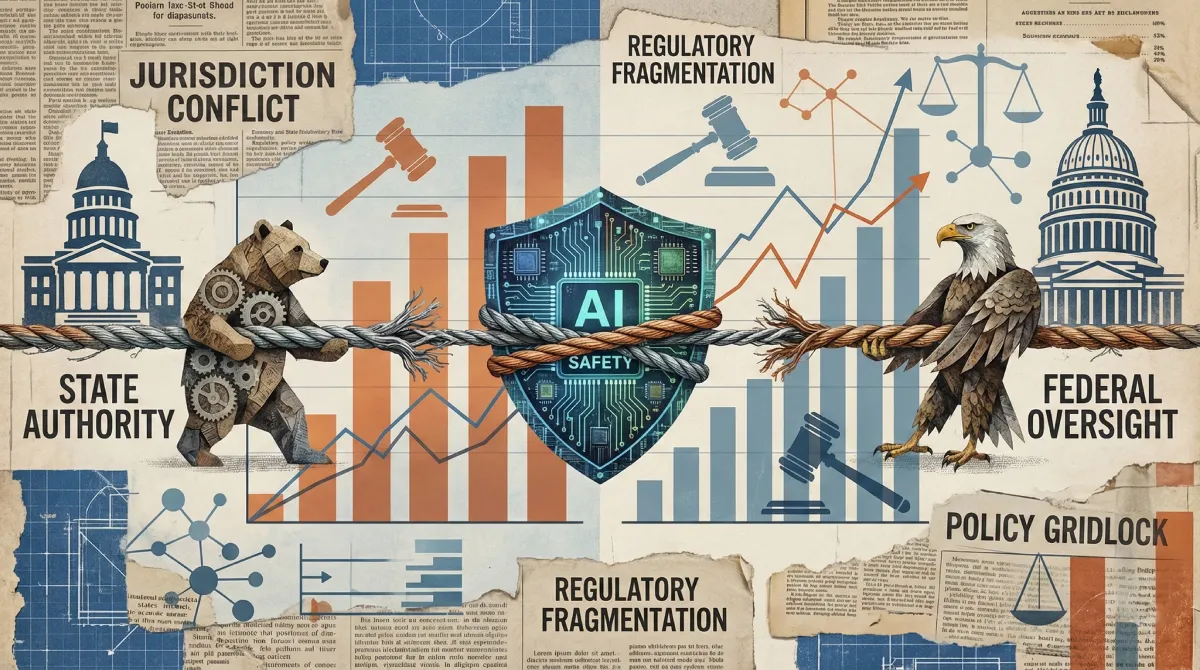
The legal landscape for artificial intelligence in the United States reached a definitive boiling point this month as New York State enacted the Responsible AI Safety and Education (RAISE) Act. Signed by Governor Kathy Hochul on December 19, 2025, the law establishes a stringent oversight regime for frontier AI models, effectively defying a recent federal executive order from the Trump administration designed to preempt state-level tech regulation. This burgeoning conflict between Albany and Washington marks a critical juncture for the industry, as developers now face the prospect of a fractured regulatory environment where state mandates for transparency and safety collide head-on with federal efforts to maintain a “minimally burdensome” national policy.
The RAISE Act represents a significant escalation in the quest to govern machine learning systems that possess the scale and compute power to pose “critical harms.” By targeting companies with more than $500 million in annual revenue—or those utilizing over $100 million in computational resources for training—New York has positioned itself as the nation’s primary regulator of the “AI frontier.” For the technology sector, this is not merely a regional policy shift; it is a fundamental challenge to the federal government’s authority to dictate the speed and safety of innovation in the 21st century.
Technical Rigor: The Architecture of the RAISE Act
Technically, the RAISE Act moves beyond the “light-touch” voluntary commitments previously seen at the federal level. It mandates that developers of frontier AI models—such as OpenAI, Meta, and Google—must formalize and publish detailed safety and security protocols. These protocols are specifically engineered to mitigate high-consequence risks, including the use of AI to develop biological weapons, execute large-scale automated hacking, or facilitate sophisticated criminal activity.
One of the most consequential technical requirements is the 72-hour reporting window. In the event that a model exhibits “dangerous behavior” or is subject to an unauthorized theft of its underlying weights, the developer must notify the New York State Department of Financial Services (DFS) within three days. This is notably stricter than California’s SB 53, which allows for a 15-day reporting lag. To oversee these requirements, the act establishes a new Office of AI Oversight within the DFS, which will conduct annual audits of these safety frameworks and issue public reports on developer compliance.
Comparison of AI Safety Reporting Windows
Jurisdiction Reporting Trigger Compliance Window Oversight Body
New York (RAISE Act) Critical Harm/Model Theft 72 Hours Dept. of Financial Services
California (SB 53) Significant Safety Breach 15 Days Civil Rights Department
Federal (Trump EO) Varies by Agency Non-Binding/Voluntary AI Litigation Task Force
Export to Sheets
The Federal Counter-Strike: Preemption and Funding Leverages
The enactment of the RAISE Act occurred just eight days after President Trump signed the executive order “Ensuring a National Policy Framework for Artificial Intelligence” on December 11, 2025. This federal directive aims to prevent a “patchwork” of state regulations that the administration argues would stymie American innovation and hand an advantage to global adversaries.
The executive order establishes an “AI Litigation Task Force” within the Department of Justice, specifically tasked with challenging state laws like the RAISE Act in court. The federal argument rests largely on a expansive interpretation of the Dormant Commerce Clause, suggesting that state-level safety requirements unconstitutionally interfere with interstate commerce by forcing companies to alter the “truthful outputs” of their models to meet varying regional standards.
Furthermore, the administration has introduced financial penalties for states that refuse to align with the national framework. The Secretary of Commerce has been directed to evaluate state AI laws and potentially disqualify non-compliant states from receiving federal funds, specifically targeting the Broadband Equity Access and Deployment (BEAD) program. This creates a high-stakes scenario where New York must choose between its safety regime and millions in federal infrastructure support.
Market Dynamics and the “AI Frontier” Industry Impact
For the automation and data sectors, the RAISE Act creates immediate operational hurdles. Large-scale developers must now navigate two diametrically opposed legal philosophies. On one side, the federal government promotes a “move fast” mentality, viewing safety regulations as a form of “ideological bias.” On the other, New York is building a regime predicated on the idea that high-risk models require the same level of oversight as traditional utilities or heavy industry.
Governor Hochul framed the legislation as a necessary intervention in a vacuum of federal accountability. “By enacting the RAISE Act, New York is once again leading the nation in setting a strong and sensible standard for frontier AI safety,” Hochul stated during the signing ceremony. “This law holds the biggest developers accountable… as the federal government lags behind, failing to implement common-sense regulations.”
Industry analysts expect that the “California effect”—where companies adopt the strictest state standard as their national baseline to simplify compliance—may take hold here. If OpenAI or Meta must build 72-hour reporting pipelines for New York, they are unlikely to maintain a separate, slower system for the rest of the country, effectively making New York’s law the de facto national standard despite federal opposition.
Innovation vs. Regulation: The Empire AI Context
The RAISE Act does not exist in isolation. It is part of a broader “Empire AI” strategy designed to make New York a global hub for ethical innovation. This includes a $400 million public-private consortium aimed at providing academic institutions and startups with the high-performance computing (HPC) power necessary to compete with “Big Tech” oligarchs.
By combining massive investment in AI infrastructure with strict safety guardrails, New York is attempting to prove that innovation and regulation are not a zero-sum game. However, the success of this model depends on the outcome of the inevitable legal challenges. The AI Litigation Task Force is expected to file its first brief against the RAISE Act in early 2026, setting the stage for a Supreme Court battle that could redefine the limits of state power in the age of automated intelligence.
The Takeaway: A Fractured Future for AI Policy
The collision between New York and the federal government signals the end of the “regulatory honeymoon” for the AI industry. As machine learning models become more powerful and integrated into the core of the economy, the battle for control over their safety and “truthfulness” will only intensify.
The future of AI in America now rests in the hands of the judiciary. If New York succeeds in defending the RAISE Act, it will empower other states to pursue diverse, localized safety agendas. If the federal government prevails in its preemption efforts, the U.S. will move toward a unified, developer-friendly framework that prioritizes speed and competitiveness above all else. For now, the “Wild West” of AI has been replaced by a courtroom drama with the highest possible stakes.
Source: https://gizmodo.com/new-york-state-just-put-itself-on-a-legal-collision-course-with-trumps-ai-policy-2000702258
Would you like me to analyze the specific technical documentation requirements for AI safety protocols under the RAISE Act to help your compliance team prepare for the 2026 reporting cycle?