Decoding Credibility: The Strategic Audit for AI Search Visibility in 2026
The traditional search engine results page (SERP) is no longer the sole arbiter of digital visibility. As generative search engines like ChatGPT, Perplexity, and Google’s AI Overviews become the primary discovery layer for users, the mechanics of “ranking” have shifted toward “citation.” In 2026, appearing in an AI-generated summary depends less on keyword density and more on a brand’s ability to project “trust signals”—a complex set of indicators related to identity verification, third-party evidence, and technical integrity. For enterprises, understanding and auditing these signals is now a critical operational requirement; failing to do so risks being filtered out of the conversational answers that increasingly mediate the path to purchase.
The Three Pillars of AI Trust Signals
AI search engines do not simply “crawl” the web; they evaluate and assemble meaning from a multitude of sources. To minimize the risk of hallucinations, these systems prioritize brands that exhibit high levels of transparency and verifiability. This credibility is assessed through three core categories: Entity Identity, Evidence and Citations, and Technical Health.
1. Entity Identity: Verifiable Digital Signatures
In an AI-first environment, your brand is an “entity”—a distinct node in a machine’s knowledge graph. AI systems cross-reference data across platforms to confirm that an organization is who it claims to be. A primary tool for this is Organization Schema, a piece of structured data that explicitly tells search engines about a brand’s name, logo, and official web properties.
A critical technical feature within this schema is the “sameAs” link. By linking a homepage to official profiles on LinkedIn, Crunchbase, or Wikipedia, a brand provides the machine with a trail of evidence. If a brand’s name or descriptors vary across these platforms, AI models may treat them as separate, less credible entities, leading to a “comprehension budget” failure where the system simply stops trying to resolve the ambiguity.
2. Evidence and Citations: The Peer Review of the Web
AI systems have a clear preference for content that is vouched for by credible third parties. High-trust backlinks from governmental (.gov), academic (.edu), or major industry publications act as digital endorsements. However, 2026 has seen the rise of unlinked brand mentions as a major currency of authority. When experts on Reddit, contributors to industry podcasts, or journalists at major news outlets discuss a brand, it reinforces that brand’s status as a topical authority even without a direct hyperlink.
Furthermore, internal source attribution has become a prerequisite for citation. AI models favor content that links directly to primary research, official statistics, or peer-reviewed studies. A standard pattern in high-performing content now includes clear, visible citations: “According to [primary source], [finding].”
3. Technical and UX: The Foundation of Reliability
While often overlooked in favor of content strategy, technical signals like Core Web Vitals (CWV) and HTTPS encryption serve as proxies for a site’s safety and reliability. Fast-loading, stable pages (measured by Largest Contentful Paint and Cumulative Layout Shift) indicate a high-quality user experience. Because AI search engines often source their data from the top performers in traditional search indices, these technical foundations are the “entry fee” for consideration in generative responses.
Performing a Practical Trust Audit
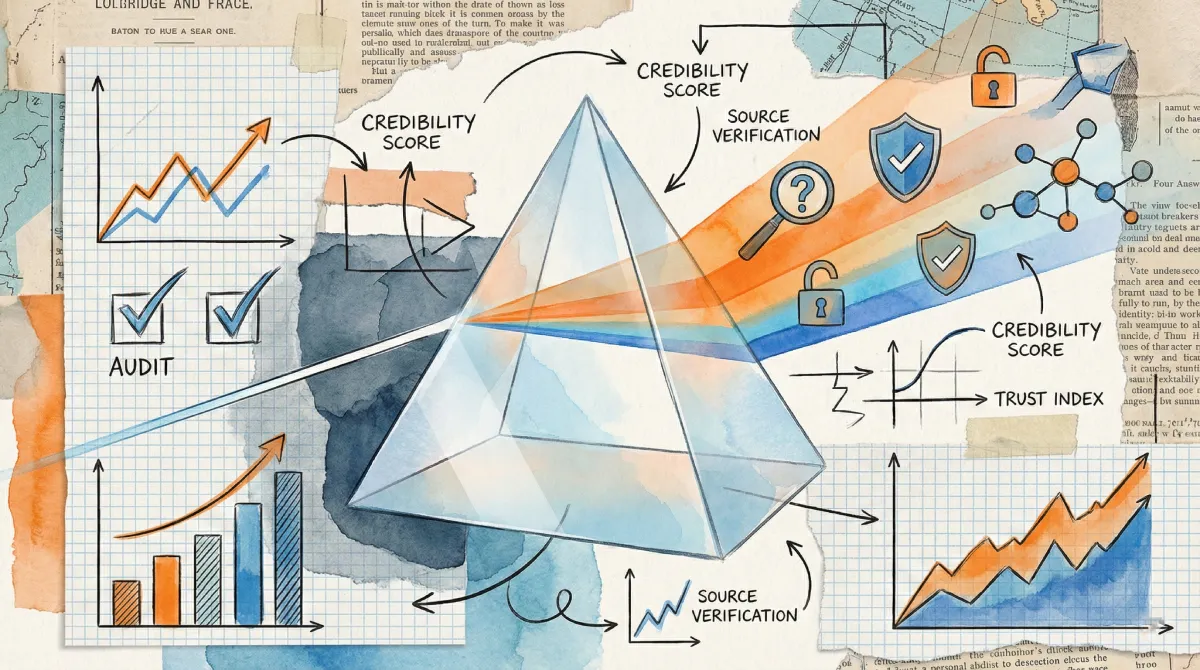
To manage visibility, marketing teams are adopting a standardized scoring system to identify credibility gaps. An audit of these signals provides a roadmap for where to invest resources—whether in technical fixes, PR efforts, or data restructuring.
Score Strategic Meaning Operational Focus
0-3 Points Critical Gaps: The brand lacks the basic proof points for AI systems to cite it with confidence. Implement foundational Organization schema, secure HTTPS, and create “sameAs” links.
4-6 Points Foundation in Progress: Some signals exist, but inconsistencies across platforms create friction. Standardize brand naming (NAP data) and focus on earning mentions in trade publications.
7-9 Points Strong Profile: The brand is well-established as a credible entity and a regular source of data. Optimize content formats for “answer extraction” and track which specific prompts trigger citations.
Export to Sheets
Market Impact: The Shift from Clicks to Citations
The shift toward AI-mediated discovery is fundamentally altering the economics of the funnel. Total site visits for generic informational queries are declining as users get their answers directly from AI summaries—a phenomenon known as “zero-click” search. However, the traffic that does arrive is increasingly high-intent. Users who click through from an AI citation have already been “pre-sold” on a brand’s credibility.
For e-commerce, the impact is even more pronounced. AI “agents” are now beginning to act as personal shoppers, comparing product specifications and reading reviews on behalf of the user. To be discovered by these agents, brands must ensure their product data is “machine-callable”—highly structured and consistently labeled across all digital touchpoints. Brands that ignore these signals face an uphill battle against competitors who have effectively “mapped” their entities into the AI ecosystem.
Future Outlook: The Year of Reputational Refinement
As we move through 2026, AI models are becoming more adept at spotting manipulation. Short-term “hacks” or low-quality AI-generated content used for “Answer Engine Optimization” (AEO) are increasingly penalized in favor of original research and lived experience. The future of digital visibility belongs to brands that treat trust as a technical asset.
“Visibility is not the only goal; I want to see if my brand and product are described accurately and consistently,” notes Alex Birkett, Co-Founder at Omniscient Digital. This highlights a shift in sentiment: in an AI-driven world, a brand’s reputation is no longer what it says about itself, but what the broader internet—and the machines that read it—proclaim it to be.
The clear takeaway for 2026 is that AI search is not a replacement for traditional SEO, but an evolution of it. By closing credibility gaps today, brands can ensure they remain not just visible, but trusted, in the conversational search landscape of tomorrow.
Source: https://www.semrush.com/blog/ai-search-trust-signals/