Biological Bitstreams: Atlas Data Storage Debuts Synthetic DNA Archive to Address AI Data Proliferation
In a move that could redefine the lifecycle of digital information, U.S. biotech firm Atlas Data Storage has officially launched the Atlas Eon 100, a synthetic DNA storage system designed to preserve massive datasets for millennia. Announced following a decade of research and development, the system offers a storage density 1,000 times greater than traditional magnetic tape, effectively fitting the equivalent of 10 billion songs into a single liter of liquid solution. As the generative artificial intelligence boom creates an unprecedented “data hunger”—with society currently generating approximately 280 petabytes of data every minute—traditional silicon and magnetic media are struggling to keep pace. The introduction of DNA-based archival solutions marks a critical transition toward molecular computing, promising a stable, energy-efficient medium for the long-term safeguarding of high-value content, scientific records, and AI training models.
The significance of this launch lies in its potential to solve the “bit rot” problem that plagues current storage technologies. While hard drives fail within a decade and magnetic tapes require strict climate control to survive thirty years, DNA is a time-tested medium capable of maintaining structural integrity for centuries. By mapping binary code onto the chemical bases of life, Atlas Data Storage is positioning DNA not just as a biological blueprint, but as the ultimate cold-storage hardware for a civilization increasingly dependent on permanent digital memory.
Technical Architecture: Mapping Binary to Biology
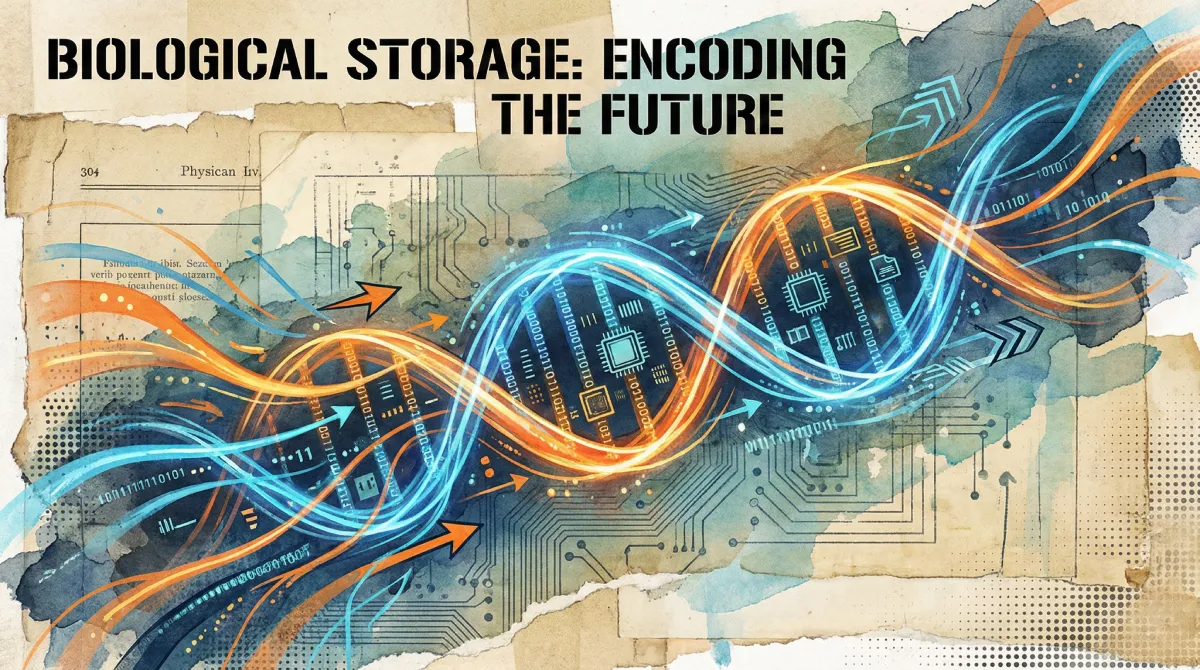
The fundamental innovation of the Atlas Eon 100 is the translation of digital information into a molecular format. In traditional computing, data is stored as a sequence of 1s and 0s. The Atlas system replaces this binary logic with the quaternary logic of DNA, using the four chemical bases: adenine (A), cytosine (C), guanine (G), and thymine (T).
The Encoding and Synthesis Process
To store a file, the Atlas software maps binary sequences to these chemical bases. For example, an encoding scheme might assign A to represent 00, C to 01, G to 10, and T to 11. Once the sequence is defined, artificial DNA is synthesized in a laboratory, arranging the bases in the exact order required to reconstruct the file.
Stabilization and Storage
Unlike the wet DNA found in living organisms, the data-carrying DNA in the Eon 100 system is dehydrated and stored as a shelf-stable powder. This powder is encased in 0.7-inch ruggedized steel capsules. These capsules are designed to endure temperatures up to 104 degrees Fahrenheit (40 degrees Celsius) in a standard office environment with a reported reliability of 99.99999999999%. When the data needs to be accessed, the powder is rehydrated and processed through a standard DNA sequencer, which translates the chemical bases back into digital binary.
Context in the AI and Big Data Landscape
The emergence of DNA storage is a direct response to the infrastructure crisis caused by machine learning and automation. Generative AI models require vast repositories of training data, and the outputs of these models are, in turn, creating a feedback loop of ever-expanding data volumes.
Currently, the primary medium for archival storage is Linear Tape-Open (LTO) magnetic tape. However, the physical footprint of tape is becoming unsustainable. To store 60 petabytes of data—the capacity of one liter of Atlas DNA solution—an organization would require approximately 15,500 miles of LTO-10 tape. DNA storage eliminates this spatial requirement, offering a sustainable path for “cold data” that does not need to be accessed frequently but must be preserved with absolute fidelity.
Furthermore, DNA storage offers a unique advantage in data replication. Once a master strand of data-encoded DNA is synthesized, enzymes can be used to create billions of identical copies in just a few hours. This makes the creation of geographically dispersed backups significantly more efficient than copying petabytes of data across hard drive arrays.
Market Impact and Economic Challenges
While the technical potential of the Atlas Eon 100 is vast, the commercialization of DNA storage faces steep economic hurdles. The industry is currently grappling with the high costs of both synthesis (writing) and sequencing (reading).
The Cost of Synthesis
Writing data to DNA remains the most significant bottleneck. Synthesis is an intricate chemical process that currently has lead times ranging from several days to a week. Experts note that for DNA to be competitive with magnetic tape, the cost of synthesis must drop by several orders of magnitude.
Sequencing Throughput
On the retrieval side, sequencing costs are falling faster than Moore’s Law, but the process remains slow. Recovering a single file can take upwards of 25 minutes, making it unsuitable for “hot data” or active workflows. Consequently, the DNA Data Storage Alliance suggests that widespread adoption for archival purposes is likely three to five years away.
Professor Thomas Heinis of Imperial College London remains cautious, citing the recent bankruptcy of other players in the space, such as Catalog DNA. He emphasizes that “you cannot read cheaply what you cannot afford to write,” highlighting that until synthesis becomes economically viable, DNA storage will remain a niche solution for only the most high-value heritage content.
Product Background: From Twist Bioscience to Atlas
Atlas Data Storage originated as a spin-off from Twist Bioscience, inheriting a proprietary silicon-based DNA synthesis platform. This heritage gives Atlas a head start in manufacturing throughput, as Twist is already a leading provider of synthetic genes for the pharmaceutical and research sectors.
“This is the culmination of more than ten years of product development,” said Bill Banyai, Founder of Atlas Data Storage. The company’s focus is now on optimizing the Eon 100 for enterprise-level archiving, specifically targeting industries like film preservation, scientific research, and national libraries where data loss is not an option.
Future Implications and Conclusion
The launch of a commercial DNA storage product represents a major milestone in the history of information technology. If Atlas can successfully navigate the scaling challenges of synthesis, DNA could become the standard for “eternal” archiving. This shift would reduce the massive energy footprint of modern data centers, which currently require constant power for cooling and maintaining magnetic and flash media.
As we move toward 2030, the integration of biological and digital systems will likely deepen. The takeaway for the technology sector is that the future of data may not be found in ever-smaller silicon transistors, but in the molecular structures that have preserved biological information for millions of years. For now, the Atlas Eon 100 serves as a bridge between these two worlds—a ruggedized, steel-encased promise that humanity’s digital legacy can survive long after its current hardware has turned to dust.
Source: https://www.livescience.com/technology/computing/this-new-dna-storage-system-can-fit-10-billion-songs-in-a-liter-of-liquid-but-challenges-remain-for-the-unusual-storage-format
Would you like me to research the current energy consumption comparisons between DNA storage vaults and traditional tape-based data centers, or shall we explore the latest breakthroughs in enzymatic DNA synthesis that could lower write costs?